Eye On Modesto

Thoughts and observations about Modesto and Stanislaus County

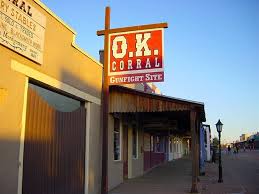
Mayor Marsh’s O.K.Corral at Hart Ransom in Wood Colony

By Emerson Drakeokcorral

It was just after high noon when Mayor Marsh tried to face down the crowd at Hart Ransom Elementary School in Wood Colony.  The Mayor started out on the wrong foot when he reminded the audience he once had a teaching credential and he was here to educate them in Modesto politics and how to count to four.   Unfortunately for Marsh he’s allowed his educational skills and debating skills to get rusty.  The Mayor has gotten used to a semi-controlled environment of the council chambers where he can threaten dissenters with expulsion if they disagree or interrupt him with the truth.  He has also forgotten that truth is his best weapon because he left it at home on Saturday.  And to top it all off, many of the audience members are much better informed than he and most are more knowledgeable than Council members John Gunderson and Jenny Kenoyer, who were also present but silent.  The two council members riding shotgun that day must have decided to keep silent and let people wonder instead of talking and removing all doubt as to their lack of understanding the basics of the issues.

Early on he was forced to say “I’ll take that back” three times in ninety seconds as a member of the audience (they all appeared to be residents of Wood Colony) would correct statements he made and these were just a few of many mis-statements he made and was corrected on. The ever polite and politically neutral  Marjorie Blom,  LAFCO’s (Local Agency Formation Commission) Executive Officer,  would speak later displaying her knowledge and understanding by explaining the process correctly  without pointing out the mistakes Marsh made.

And yes Mayor Marsh did blame Wood Colony residents for not coming out to Modesto’s meetings starting a year and a half ago.  Their absence wasn’t  surprising since Marsh had mentioned annexing  Salida in his Inaugural/State of the City Address but had failed to mention Wood Colony.  But politicians like to play the blame game and yes he had to take that back too.  The Mayor brought former councilman Denny Jackman into the conversation several times for support, especially for RUL (Residential Urban Limits).  For those followers of politics, the Mayor was careful when he chose to get Denny’s endorsements and Denny was just as careful as to what he agreed with.  But to the uninitiated it appeared to come off smoothly.

We’ve come to believe the compromise Denny struck trying to get a version the Council and Chamber could support, is too watered down to be effective.  To enlist the Chamber’s support they had to offer up the public’s last vestiges of control and that is Measure’s A and M, and allow them to be put on the ballot for repeal.  When that was discussed you could actually see Cogdill and Zoslocki become excited.

The Mayor wasn’t completely disingenuous, he stated although he is a farmland preservationist he isn’t one 100 percent of the time, not even ninety percent according to his own words.

The Mayor had kind words for Councilman Zoslocki calling him a likable and deeply religious man like himself.  Just that they disagreed on farmland preservation.  I admit at this point I did start laughing out loud for a moment.  Here’s the thing, most everyone agrees Marsh is an intelligent man, he just isn’t always politically savvy.   By the way, Mayor Marsh put the voting suggestions forward and by his unwillingness to lose a vote to keep Wood Colony out of Modesto’s General Plan, he allowed Zoslocki, Cogdill and Lopez to vote to keep it out while his block voted to keep Wood Colony in.  It is an upside down world when this happens, since Zoslocki had been traveling from one Planning Commission Workshop to another with the Chamber of Commerce all last year in an attempt to take Modesto’s General Plan all the way to the river for the western boundary.  Zoslocki, Cogdill and Lopez are the most Chamber/builder friendly people on the council with Madrigal coming right after them.

The Mayor addressed the recall talk towards Gunderson and Kenoyer by saying if they were recalled, Modesto/Wood Colony/Salida would only get someone worse.  In all fairness we’re not sure that’s possible considering the way they voted on Jan.28th.  The recall discussion regarding Jenny has been loud but the conversation regarding Gunderson had only begun to be strident when he started cutting himself off from his constituents who disagreed with his voting positions.  It was a childish move and left many shaking their heads in disillusioned astonishment, which is an action many of his council mates have done since he was elected.

It truly seems to me the problem originated with the Modesto Chamber of Commerce and I discussed this and pointed it out during the public comment period with the Stanislaus County Board of Supervisors several times at January meetings.  The Chamber was allowed to frame the argument as jobs vs prime farmland but that just isn’t the case.  When I had my conversation with Jenny Kenoyer on Jan. 7th about saving Wood Colony, she responded by saying “give me an alternative.” So I immediately pointed out the North County Corridor and the County’s prediction that it would be completed many years before 132 goes all the way to Interstate 5 in an expanded form and that the soils east of Modesto were far poorer, unofficially referred to as  PPP (piss poor pasture) by farmers and that was where we should be building business parks and homes.  But Jenny had, to use the vernacular, drank the Chambers get rich quick kool-aid and ignored the suggestion and only wanted to consider Wood Colony.  And yes that was when she uttered the now famous words, “I have to worry about the 200,000 people living in Modesto and besides those people in Wood Colony can’t vote for me.”  She repeated those words three different times so I’m sure I wasn’t the first or the last person she had said them to.

It was great to see that the citizens of Wood Colony had thoroughly educated themselves about the issue and were defending themselves quite adequately.  They weren’t buying the half truths Marsh was selling and told him point blank he needed to bring the issue back to the council and take Wood Colony completely OUT of Modesto’s General Plan.

I fully admit I voted for Marsh and Gunderson believing then and now they were the lesser of two evils.  I guess it goes to show we need a better class of politicians in Modesto.

We hope to have the audio from the meeting up soon.

Here is a Counter to Marsh’s Letter: Don’t believe Marsh’s Ag-friendly ‘Smokescreen’

By Katherine Borges and Valerie Goldstein keepwoodcolonygreen

Reality is the state of things as they actually exist and not as they may appear or are imagined.

Modesto Mayor Garrad Marsh’s Op-Ed in last Sunday’s Bee (“Mayor: Council acted to protect farmland,” Feb. 9, Page D1), attempts to justify the City Council’s “unprecedented” votes on the general plan update. The reality of the plan means annexation and development for Wood Colony and Salida behind Marsh’s “ag-friendly” smokescreen.

The first item addressed by Marsh is the “return” of the Beckwith Triangle from the general plan. The area was slated to become a ballpark along with commercial and industrial development, which Marsh now describes as an “unsound plan.” The Beckwith Triangle is still a part of Modesto’s new plan update, just with a different zoning mix. But more importantly, how can something be “returned” when it was never yours to begin with?

His next paragraph is an acknowledgment of just how much the Modesto Chamber of Commerce controls the council. Despite the massive and well documented public outcry against including Wood Colony in the general plan, the council conceded to a compromise with the chamber of “around 1,000 acres.” Marsh even refers to it as a “pristine agricultural treasure,” but zones it for both commercial and business park with a gerrymandered notch on Beckwith to try to prevent residents from voting down the annexation.

Marsh’s third point of ag mitigation is nothing more than a damage-control diversion for Jenny Kenoyer’s political gaffes. Stanislaus County already has an ag mitigation policy in place, yet Modesto’s has not yet been approved; which Marsh alludes to with, “If completed … ”

In his fourth attempted rationalization, Marsh cites “1,500 acres of land that was targeted for housing back to ag and out of the General Plan.” To remove LAFCO-approved land in exchange for land that LAFCO previously voted against being urbanized is not commendable but is, in reality, irresponsible planning. (LAFCO is the county commission which approves/denies land annexations.)

Most wouldn’t even know that Salida was included based on Marsh’s skillfully crafted wordsmithing. The land around Gregori High is part of the Salida Community Plan, an initiative passed by the Board of Supervisors for Salida in 2007. To put it another way, Marsh is saying, “ … the best and quickest way for Modesto to attract more jobs without taking any land that retained its agricultural zoning” is to steal it from Salida. The land currently around Gregori is zoned ag and the council has repeatedly admitted the jobs produced are 25-40 years out.

The last Trojan Horse that Marsh trots out is the Residential Urban Limits (RUL), which if approved by voters, would send to ballot any time a residential developer wants to build on farmland. As if the people of Wood Colony are going to respond, “It’s OK for you to bulldoze my house as long as you don’t build another house in its place.”

Like the aforementioned ag mitigation, Stanislaus County already has a rural urban limit in place, Measure E (co-authored by Denny Jackman and … wait for it … Garrad Marsh) passed by voters in 2007. Yet for Wood Colony and Salida, RULs will not apply since neither land-jacking by Modesto involves residential development plans.

Modesto neighbors, please help us! With Salida and Wood Colony united to protect our homes, our farms and our communities, every member of your City Council cast a vote against us. They aren’t listening to us and they aren’t listening to you. We cannot recall them, but you can. Join your district’s recall effort and help take your city back from the money interests. We just want to live our lives in peace without the threat of losing our homes and communities.

By Katherine Borges and Valerie Goldstein


Mayor’s Letter to the Modesto Bee and the Citizens of Modesto

Mayor Marsh’s Letter to the Modesto Bee

February 6, 2014 at 8:05pm gmarsh

Often there is perception and then there is reality. The City Council actions on the General Plan Update have, for most, been perceived differently from what is real.

The most far reaching recommendations to protect our agricultural economy ever in Modesto’s history were proposed by the Modesto City Council. At the January 28th Council meeting, the General Plan (of our land use) was recommended to be amended.  Unlike reports and some general concepts of the votes taken, these votes were unprecedented in the history of Modesto.

There were four votes to preserve ag that evening that were unlike any former votes ever made by a Modesto City Council.  This seemed to be missed in the reporting and in the general public’s understanding of the events of that long evening.

First, Modesto REVERSED an almost 20-year general plan policy by RETURNING over 800 acres of Wood Colony to agricultural zoning. In 1995 Modesto designated the “Beckwith Triangle” to become business, industrial, and commercial uses.  This council is abandoning the scope of that former unsound plan.

Second, your City Council rejected the Modesto Chamber of Commerce’s plan to convert almost another 1,000 acres of Wood Colony into industrial and business park uses.  The Chamber had actively lobbied your Council to target this pristine agricultural treasure for development. Modesto Chamber’s early plan was to take over 4,000 acres of Wood Colony, but Modesto staff lowered that to about a thousand.  I believe Modesto’s Council has never before been so agricultural friendly as to rebuff the developer packed Chamber’s proposal.

Third, based upon feisty Councilwoman Jenny Kenoyer’s motion, Modesto moved forward the idea of farmland mitigation. Never in Modesto’s history has it taken steps to enact a policy to save farmland. On a narrow 4-3 vote this policy change moved forward. If completed it would require permanent protection of agricultural land equal to any land the City takes into its city limits.

And fourth, Modesto is returning 1,500 acres of land that was targeted for housing back to ag and out of the General Plan. It also is returning 320 acres of business-designated land to agricultural uses.  What especially makes these plans unparalleled is this land was already blessed by LAFCO (the countywide land authority on urbanization) to let Modesto develop. Think of that. Modesto is taking prime farmland that has for decades been planned to be paved over for housing and returning it to agricultural uses.

I am of the opinion that those who have had undue influence over the city’s council for far too long, were shocked by the results of Jan. 28th’s actions. There have even been whispers of recall.  Really?  A recall because the importance of ag was finally recognized by action.  This Council finally put our agricultural heritage ahead of money.

Besides those extraordinary votes, the Council took action to secure well-located business property for the future. I support the idea of moving forward on the business designated land around Gregori High.  The County Board of Supervisors had already given a 25 year right for developers to build on this land.  This is the best and quickest way for Modesto to attract more jobs without taking any land that retained its agricultural zoning.

One other vote from the week previous to the General Plan agenda also got no coverage. The City Council moved a residential urban limits (RUL) question to the next City ballot. If approved by the voters, this would build a wall between Modesto and prime farmland for building of homes.  Again, an historic move by this Council.

If anyone would like more information on these historic steps toward Modesto’s recognition of agriculture’s importance to our economy or the votes taken by your council, I would be pleased to meet with you. Email gmarsh@modestogov.com.

I will be presenting the State of the City address on Wednesday, February 26th at 5:30 p.m.  The address will be given in the City Council chambers, lower floor of the City-County building, 1010 10th street.  Questions will be taken at the end of the address.

Garrad Marsh, MayorCity of Modesto

3700 McHenry Ave.Modesto, CA 95356209-417-7991

mchbowl@aol.com

We’ve added Marsh’s letter to the Eye to future reference it.  It has been spread on facebook days before being printed in the Bee.  We will respond to its contents at a future date.

State of the County, 2014 – Challenges and Opportunities

By Chairman of the Board of Supervisors Jim DeMartiniJimDeMartini

Good morning my fellow members of the Board of Supervisors, CEO Risen, County Counsel Doering, those who are in the chambers today and those who might be watching on television or over the internet.  It is a privilege to present the state of the county address for 2014.

Stanislaus County is a big place, over 1500 square miles.  More than 520,000 of us live in our nine cities and unincorporated communities.  Two of California’s three major north/south transportation corridors, Highway 99 and Interstate 5, come through us.  Three rivers, the San Joaquin, the Toulumne and the Stanislaus, give us drinking water, allow our crops to grow and contribute to our recreation and relaxation.  We have a California State University, a community college and several private educational outlets.  And of course, we are close neighbors with UC Merced.

Stanislaus County’s government itself is big.  We have 3900 employees, 26 different departments and an annual budget of more than 1 billion dollars.  Because of the recession, we do the same amount of work, if not more, than in 2008, but with 750 fewer employees.  And those who work for the county have seen their wages reduced as we have tried to meet the new fiscal realities.  We owe them a debt of thanks for their dedication and commitment in trying times.

The employees of Stanislaus County continue to be our greatest asset.  Over the last few years County employees have been asked to do more with less and have responded.  Everyday our employees are out on our roads, in our neighborhoods and working in our departments providing services to the members of our community.  On June 30, 2014, labor contracts for all represented County employees will expire.  Over the next six months, the County will be working to complete negotiations with all twelve County labor groups.  Our goal will be to recognize the value of our employees while ensuring the County remains fiscally viable in light of the uncertainty surrounding the long term economic recovery.

We have big, and at times, daunting challenges.  Our unemployment rate is too high.  We have a water crisis.  We need to improve public safety for our residents.  Most importantly, we need to restore hope.  Too many of our neighbors believe that the avenue of opportunity is closed to them.  It isn’t, but they remain to be convinced.

The foundation of Stanislaus county’s economy is agriculture.  I want to speak a bit about this not just because it is my profession, but because it is so important to all of us, and because it represents the foundation upon which hope and opportunity can be built.

We sometimes take agriculture for granted.  We shouldn’t.  In Stanislaus County, it is a multi-billion dollar business.  The value of agriculture commodities produced in Stanislaus County is over 3 billion dollars.  With the multiplier effect the impact in Stanislaus County is 11 billion dollars a year.  Ag related business such as E & J Gallo Winery, Del Monte, Foster Farms, Seneca, Stanislaus Food and ConAgra are some of the county’s largest employers.

My family emigrated from Switzerland and has farmed in Stanislaus County for more than 100 years.  I am my family’s third generation and I’ve been a farmer for over 40 years.  The San Joaquin Valley and Stanislaus County in particular, is the most productive and bountiful farm ground in the world.  The Mediterranean climate that we enjoy is extremely rare in the world.  Couple that with our productive soils and an extensive irrigation system fed by the Stanislaus, Toulumne and San Joaquin Rivers, and we have the ability to grow more than 200 different crops.  This is unique n the world.  Today this valley leads the nation and the world in production of almonds, walnuts, peaches, apricots and milk.  It is the envy of other agricultural parts of our own country.  In the national and worldwide agricultural community, California is known more for its agricultural products than for Hollywood, our beautiful coastline or the Silicon Valley.

Through the years we hear of Stanislaus County becoming an economic engine for industries other than agriculture, but much of that is unrealistic.  We will never be a tourist mecca like the coast.  Nor are we going to attract the California film industry here or become another Silicon Valley.  I am not suggesting we shouldn’t diversify and look for other opportunities, but we need to lead with our strength.  Our strength is agriculture.

Unemployment is chronic in our county.  According to a report from California State University Stanislaus, employment in the valley lags behind the state in employment growth.  In order for there to be growth in employment, we need diversity in our economy that will provide jobs that complement our economic base.  The medical industry is one example of this, and it employes over 10,000 people here.  Warehousing and Distributing have added many good paying jobs with the Patterson area gaining the most.  We can add jobs in Riverbank at the ammunition plant.  Turlock has developed its job center area with the Blue Diamond plant as its foundation.  Hilmar cheese plans an expansion there also.

We need to take advantage of our fine educational institutions and partner with UC Merced, CSU Stanislaus and MJC.  The new leadership at these educational institutions is poised to work with business leaders and others to assist in not only sustainable job growth but economic growth.  We need to be more aggressive in attracting more companies that will bring “core jobs” to our county.  We need our cities and the county to work more closely together to better coordinate these efforts.

Many years ago, when I was a student in a high school ag class, our teacher asked us what we wanted to do when we grew up.  Since all of us were from farm families, each of us replied that we wanted to be farmers.  Our teacher then explained that our agricultural economy is like an hour glass.  The top part of the hour glass represents all of the inputs to agriculture, the things needed to make farming work:  the tractor and irrigation companies, the people who provide the fertilizer, fuel, trucking and nursery stock, the bankers, accountants and repair shops needed by farmers.  All of these occupations fill the top of the hour glass.

The farmer and the farm worker is the narrow part of the hour glass, where the fewest amount of people are employed.  This was where all of us in that class wanted to be.  The bottom part of the hour glass represents the people and suppliers involved in the processing, distribution, sale and transportation of the farm products:  the canneries, wineries, truckers, packaging companies and grocery stores.

The point my teacher was making was that you don’t have to be on a farm to be employed by agriculture.  It is something I never forgot.  Agricultural inputs, production and processing account for 38% of Stanislaus county’s employment.   That doesn’t include the teachers, doctors, accountants, plumbers, auto mechanics and others who serve and work with those who are directly engaged.  Agriculture truly is the “big tent” that shelters all of us.

We have the most productive and abundant agricultural industry the world has ever seen.  In the United States in 1900, the average family spent 43% of their income on food.  In 1950 that percentage went down to 30%.  Today only 9% of the average family’s income is spent on food.  When the United States Department of Agriculture expanded its activities in the Great Depression, our leaders said the purpose of our agricultural policy was to provide Americans with a health, inexpensive, abundant and varied food supply.  It is fair to say that California, and our valley, have been instrumental in achieving that purpose.  We ought not, and we will not, risk this resource.

Agricultural land should not just be considered the inventory for the next housing tract or warehouse.  Ag land is an important and irreplaceable natural resource that is responsible for employing more people than any other industry in this county.  It is time we recognize this reality.  We will not improve ourselves by paving over our most productive agricultural land or by simply becoming a bedroom community for the Bay Area.  It is important that we recognize the uniqueness of what Stanislaus County has and build on that strength.

No one understands agricultural policy and its importance like people from Stanislaus County.  That is why our county has produced two United States Secretaries of Agriculture: Ed Lyng and Ann Venemen, and four California Directors of Agriculture: Henry Voss, Clare Berryhill, Anne Venemen and Bill Lyons.  Much of the national and state agricultural policy has been driven by Stanislaus county citizens.  Agriculture is in our blood.

The Stanislaus County Supervisors have addressed some of the challenges facing agriculture.

*  We adopted the Right to Farm Ordinance, which recognizes the right to farm in a manner consistent with accepted customs and standards.  This has protected our farmers from frivolous law suits and unrealistic demands.

*  We extended the Williamson Act to protect agricultural land and open spaces.

*  We passed the Ag Element which recognized the importance of our agricultural sector and set goals and objectives that include enhancing the marketing and promotion of agriculture, protecting food safety, soil erosion prevention and water conservation.

*  We passed the first agricultural preservation requirements in the San Joaquin Valley, stipulating one acre of land be set aside in perpetuity for every acre of land taking out of production for construction of residential housing.  Although Stanislaus County was sued by the Building Industry Association, we prevailed.

*  Citizens adopted a measure requiring countywide voter approval of any new residential developments in the unincorporated areas.

*  The Stanislaus Local Agency Formation commission (LAFCO) now requires cities without our county to adopt a Plan for Agricultural Preservation.  CaLAFCO recently awarded our Local Agency Formation Commission two of its highest honors:  Most Effective Commission and Project of the Year for its Agricultural Preservation Policy.

*  2014 marks the 100th year of the establishment of the Stanislaus County Farm Bureau and the UC Cooperative Extension.  Both organizations have done much to benefit our agricultural industry.  The UC Cooperative Extension provides research, education and technical assistance that helps our farmers develop best management practices and makes them more competitive in the world market.  The Stanislaus County Farm Bureau represents farmers and ranchers at all levels of government and consistently is a strong and positive voice for all sectors of agriculture.  Both organizations have given Stanislaus County 100 years of outstanding service.  We look forward to their continued leadership in meeting the challenges of the next 100 years.

But despite these successes we still have further to go.  We face serious challenges in two major areas:  transportation and water.

TRANSPORTATION

Evey industry in this county, including agriculture, relies on a sound transportation system to move its people, goods and services.  Counties with a local transportation tax, which we refer to as “self-help” counties, are able to use local dollars to leverage billions of Federal and State dollars each year for improving their transportation systems.  This in turn helps create jobs, expand mobility and enhance local communities.  Currently over 81% of California’s population resides in a self-help county, placing Stanislaus County at a huge disadvantage when it comes to competing for limited transportation funding.  Local leaders broadly accept that we need to be a self-help County.  But if we do ask voters to consider the issue again, StanCOG must develop an allocation plan with the cities and the county, and a list of county-wide projects that we all can agree on.  I call on each city council of our nine cities, as well as the County Board of supervisors to pass a resolution agreeing on the allocation formula and the county-wide road  projects.  This unified focus is essential to gaining the trust of and support from the voters on this important issue.  Unless the County and the cities move as one on a transportation measure, we will not be successful.  The model that nearly passed in 2008 should b the basis of any new proposal.  Partnership and cooperation is the key.

In that election, a change of only 70 votes out of over 160,000 cast would have given us the 2/3 margin we needed.  No one likes tax increases, but we can only move this forward if we act together.  But if we don’t move together, we will not move at all.

WATER

Another major challenge is water.  We are over pumping at an alarming level.  Management of the county’s groundwater is a new arena for us.  Every city in Stanislaus County relies on groundwater for drinking water.  To a great extent, agriculture relies on groundwater.  The current drought conditions have focused our attention on this vital natural resource.  The depletion of the groundwater resources that serve our County is not simply a drought related issue; it is an issue of sustainability.  Recognizing the critical importance of a groundwater policy, this Board took action last year to prohibit its export and sale.  We have now formed a water advisory committee made up of representatives of agriculture, irrigation districts and community members.  This committee has been charged, with public input, to develop a well thought out policy that will provide a sustainable solution to groundwater over drafting.  This policy must be developed using scientific facts and it must provide us with long term solutions.  There is no value in pointing fingers and there is no time for delay.  We need to act.  if we don’t and the problem worsens, the state of California will intervene and we risk the ability to control our own destiny.

The Don Pedro Dam is now coming up for federal re-licensing.   This is a critical issue for Stanislaus County.  We need to partner with the MID and the TID to ensure we retain the water that is ours.  We must work with our local elected officials, with our representatives in Sacramento and at the federal level.  We cannot take it for granted that this will just happen.  Our entire economy depends on this effort.  Giving up any additional water from Don Pedro Dam will have long lasting negative implications for all of our citizens and our agricultural industry.

While I believe transportation and water are critical issues, there are other important concerns affecting County government and the well being of our residents.

StanCERA

The Stanislaus County Employees Retirement Association, (StanCERA) is the agency that governs the pension fund of our county’s 3300 retirees and holds in trust the retirement money of our current employees.

It is made up of public members appointed by the Board of supervisor and members elected by county employee associations.  This board has acted responsibly and with vision in difficult times.  StanCERA took a big hit in 2008 with the recession.  Our fund balance dropped by $874 million in February of 2009.  It is now at $1.7 billion.  In addition to prudent investment decisions that account for part of this gain, StanCERA adjusted its formula that governs how much money needs to be set aside to insure these obligations are met.  The assumed rate of return was lowered to a more realistic level.  We closed the rolling amortization period so debt didn’t just get put off into the future.  We have adopted a policy to reduce the risk inherent with investing in these funds.  We will take measured steps to replace some investments with guaranteed bonds so that the cash flow needs of StanCERA will always be met.  In the 2012/2013 fiscal year StanCERA’s earnings rate, as compared to other public pension funds in the United States, ranked third nationally and second in California.  Our funded ration is now close to 78%.  Our retirees, and our current employees, and county taxpayers can feel confident that their fund is well managed and based on sound financial principals.

In 2007 this Board adopted a metal theft ordinance requiring scrap metal dealers to be licensed and to record information about sellers for every transaction when individuals were selling non-ferrous metals.  Prior to the ordinance, metal theft was increasing at an alarming rate.  This ordinance was so successful that then Assemblyman, Tom Berryhill introduced a bill similar to the Stanislaus County’s ordinance and it became state law.

Today we have similar problems with walnut theft.  There re more than 38,000 acres of walnuts in Stanislaus county with a farm gate value of $220 million dollars.  Walnut theft has increased to disturbing rates.  I suspect that there is hardly a walnut grower in the County who hasn’t suffered losses.  I am generally the last one clamoring for more regulation, but walnut theft is something we must make a serious effort to stop.

As with metal theft, the problem must be addressed at the point of purchase, which in this case involves unlicensed roadside vendors not requiring proper documentation or proof of ownership by the seller.  Another concern is food safety.  Under legitimate operations processors can trace any contaminated product back to the grower.  Having roadside cash buyers mixing any and all nuts, stolen or not, erases the chain of accountability should any unsafe product be introduced.  I call on the Ag commissioner to work in conjunction with the Ag advisory board to draft a reasonable ordinance to address the increasing problem of walnut theft and present it to the board for consideration this year.

PSYCHIATRIC HEALTH FACILITY

Over the past two years, Stanislaus County has had a dramatic increase in acute psychiatric inpatient admissions.  This increase impacts bed capacity and creates a financial burden for the County.  In the past year, County staff and all area hospitals met and began a working relationship that focused on addressing the psychiatric bed capacity issues and the growing need to secure programs to meet the County’s mandated obligations.  As a result, a new 16 bed psychiatric health facility will provide psychiatric treatment services designed to require less staff than an acute psychiatric hospital, and reducing overall cost to the county by $1.5 million while providing better services to county residents.  An existing and now vacant residential facility located at the County’s Stanislaus Recovery Center site in Ceres is currently being renovated and is on track to open March 1 of this year.

CHILDHOOD OBESITY

Stanislaus County’s health delivery system has always struggled to keep pace with the needs of our community.  The Board has a strong commitment to serve the public interest by promoting a healthy community.  One health issue that merits our attention is the alarming rate of obesity among children.  In Stanislaus County more than 40% of 5th, 7th and 9th grade students are either overweight or obese.  Obesity and physically inactivity can have profound negative health consequences for children.  Increase risk of diabetes, heart disease, hypertension and stroke are just some of the potential consequences.

Obesity has become second only to tobacco use as the leading preventable cause of disease and death.  If this trend continues, for the first time in human history, today’s children could be the first generation to have a shorter life span than their parents.  Recognizing the magnitude of this problem and the serious public threat to the health and well-being of children and families, all nine Stanislaus County cities have passed resolutions to embrace policies that facilitate activities to promote a healthier lifestyle and diet.  These policies could provide increased opportunities for physical activity in our parks by encouraging walking and biking.

I call on Stanislaus County to recognize this growing problem, and pass a similar resolution as our nine cities have.  We all need to work together to assure that everyone in Stanislaus County has access to healthy foods and safe places to be active.  Providing health environments and healthy choices promotes healthy people in a healthy Stanislaus.

PUBLIC SAFETY REALIGNMENT

We have read about and many have experienced the increase of crime in our communities.  The security of our homes, neighborhoods, schools and businesses is essential to the quality of life.  If you fear to let your children go to the park, or walk to school, not much else matters.  This County will continue to make the public safety of our residents a priority.

Public Safety Realignment under Assembly Bill 109 continues to be a significant challenge for Stanislaus County.  The effects of this paradigm shift in our criminal justice system have increased our costs and affected the jail bed capacity in our County.  Our correctional facilities are at a maximum capacity and realignment has forced us into early releases from custody.  Additionally, property and drug offenses continue to impact our community.  Despite the challenges of realignment, Stanislaus county has focused on our strong collaborative partnerships and spirit of cooperation.

Our local public safety agencies and the members of the Community Corrections Partnership have taken on the difficult task of leading our local realignment efforts.

Through their leadership and planning, we have developed an effective strategy to deal with complex issues such as recidivism, substance abuse and mental illness.  Efforts have focused on implementing only those programs and services that have the best results and are proven to work.

While the state provides funding to the County, the funding is not adequate to compensate for the costs of realignment.  The number of criminal offenders we house and supervise continues to exceed state projections resulting in increased overcrowding in our jail facilities and in the number of offenders being supervised in the community.  Funding formulas used to determine the county’s allocation of realignment funding are being reviewed.  If the number of offenders sentenced locally continues to increase, and if the state does not increase the funding to Stanislaus County, other resources will be needed to fund realignment programs.

We will continue to advocate for a change in the funding formula, as well as the total dollars available for realignment so that more money can be brought to Stanislaus County.  The County will continue to work together with our public safety partners and community based organizations to effectively deal with our offender population.

WHAT WE NEED IN 2014

Cooperation is the key to meeting our challenges.  City and county government must work better together.  The dispute over the property tax administration fees was divisive.  That is behind us now and we need to come together.  We can disagree and argue, but in the final analysis we need to cooperate.  Our cities are our partners, not our adversaries.  Challenges that face our county and our communities will either be dealt with in a timely manner that results in a positive momentum for our residents or be dealt with in a way that hurts our economy and our ability to succeed.  The county and the cities don’t get a pass.  Stanislaus County doesn’t win if the cities lose and the cities don’t win if this county loses.  There will be no progress on infrastructure, on water or on other important issues unless we learn to work together.

In order for farmers to be successful, they must deal with all kinds of unforseen circumstances, which can impact the bottom line.  They are resilient, innovative and independent.  Our government needs the same approach to its day-to-day business.  Neither Sacramento nor Washington is going to come riding into the Valley and improve our schools, arrest our criminals, build our infrastructure, take care of our elderly or insure equal opportunity for our children.  They won’t safeguard our groundwater or protect our farmland in a way that best serves us.  We are the only ones who can do that.  Finger pointing may make us feel good, but the obligation to make our county more prosperous rests squarely on the 520,000 people who live here.  Events beyond our control will shape our future.  How we handle those events however, is fully in our hands.

These are big issues, but together, we are up to the task.  I want to thank my fellow board members, department heads and all the employees of this organization for their dedication and commitment to excellence.  Together we will pursue our vision of becoming “a county that is respected for its service in the community and is known as the best in America.”
Vindictiveness Doesn’t Look Good on a City Councilwoman

By Emerson Drake jkenoyer

Ms, Kenoyer had stated during her campaign she would NOT support any attempt to annex Salida.  She repeated it several times on Jan 7th.  Over the weekend she received a flyer JennyKenoyer_flyer which upset her. Apparently she was offended at being reminded of the promises she broke and of course having flyers being passed out didn’t help.

Now Ms. Kenoyer is running around telling people she’s going to teach Salida a lesson.  Watch closely and you’ll see our ‘Jenny’ vote against the very people she promised to support.

Jenny’s promises and her word seem to be worthless.   And for someone like myself who has been a constant supporter of hers for many years this is heartbreaking.

We’ve only just begun. It’s time to hold politicians accountable to the people.  The copy machines are warmed up and the people are motivated.

There’s Still time to Help Wood Colony and Salida

modestoarch

Please write your councilperson  and or all of them and tell them to leave Wood Colony and Salida alone.  Anyone can email them so please, do it now.  Also feel free to call them at 571-5597.

Marsh can be reached at mayor@modestogov.com

The rest of the council by using the first letter of their first name and their last . The email addresses follow by council district

jgunderson@modestogov.com   tmadrigal@modestogov.com  dlopez@modestogov.com  bzoslocki@modestogov.com jkenoyer@modestogov.com dcogdill@modestogov.com

Mayor and City Attorney Create Imaginary City Council Policy

By Emerson Drake gmarsh

In recent weeks we’ve made several attempts to contact the interim City Attorney for Modesto,  Adam Lindgren,  we’ve left detailed messages but Mr. Lindgren refuses to return our calls.  The first time was before the Jan. 7th meeting of the City Council to discuss the Mayor’s illegal refusal to allow those who had spoken at the Dec. 3rd meeting regarding the General Plan Amendment to speak again despite the fact that the proposal had changed significantly.  We left messages explaining the legal ramifications in an attempt to head this miscarriage of the Brown Act off at the pass. Unfortunately the City Attorney had been given the task of ‘finding’ a way to keep the people from speaking again so it became necessary to educate both he and the Mayor in public. Fortunately one of our contributors quoted the case on point (Friant Water Authority v. County of Madera) and eventually the Mayor relented and allowed those who spoke at the Dec.3rd meeting to speak again.

The second time it’s regarding the Mayors threat to remove anyone holding signs from the meeting. Admittedly it was a childish threat made in anger.  We called Mr. Lindgren, who seems to ALWAYS be out of the office,  several times but he refuses to return my call.   So as is our way, we made a Public Record Request of the city for the applicable City Charter amendment that would allow the Mayor to  take away the First Amendment rights of the attendees. The Supreme Court has ruled signs are “free speech.”   Here are the eleven pages the City responded with. If you can find where this document allows the Mayor to threaten to throw citizens out of the meeting for carrying signs please let us know.City_Council_Organization_and_Procedure (2)

Mr. Mayor, until you finally corrected yourself towards the end of the Jan.7th  meeting you violated the law,   please don’t do it Tuesday night.

JENNY KENOYER BREAKS HER CAMPAIGN PROMISE!

Dear Modesto Neighborsmodestoarch

Less than 2 months into office (and at her first city council meeting), your new Modesto City council member JENNY KENOYER 

is planning to break her campaign promise to preserve prime farmland!

During her campaign when asked how important farmland preservation is to Stanislaus County, Jenny Kenoyer replied, “Farmland preservation is probably one of the most important things that is so important to us.  Agriculture is the base of our economy” and “I’m really concerned our council that is there now is not really concerned with preservation of ag land”.

Yet at the January 7, 2014 Modesto City Council meeting, Jenny Kenoyer indicated that she supports annexing the prime farmland west of 99 known as Wood Colony for development.  She was quoted as saying,” I DON’T CARE WHAT THE PEOPLE OF WOOD COLONY THINK, THEY DON’T VOTE FOR ME.”

Your neighbors in Wood Colony need your help to protect their homes, their farms, and their families’ farm heritage!

Please e-mail or call your councilmember, Jenny Kenoyer and request she stick to her campaign pledge to preserve farmland and NOT VOTE TO PAVE OVER FAMILY FARMS IN WEST MODESTO!

E-mail: JKenoyer@modestogov.com and/or call (209) 571-5597.

CONTACT AS SOON AS POSSIBLE! – URGENCY NEEDED!  THE VOTE IS TUESDAY!

Or attend the Modesto City Council meeting on Tuesday, January 28, 2014 at 5:30 pm at 1010 10th Street Place – Basement chambers.

*To locate the YouTube video, just google “Jenny Kenoyer Interview” and the date is August 16, 2013.

We’ve just added the pdf of the flyer being distributed in Modesto.

JennyKenoyer_flyer

Today in the Name of Freedom We Start Taking the Battle to Them

By Emerson Drake7539_644398712288462_663275294_n

Okay it’s a little dramatic, but it fits.  The Modesto City Council is preparing, through its General Plan Amendment update, to annex Wood Colony and possibly Salida and I say enough is enough.  Unlike the beleaguered citizens of Modesto, residents of Wood Colony and Salida have a means to fight back.  Marketplace Shopping Center is a prime example.  Modesto residents came out in droves to protest the building of the center at Sylvan and Oakdale roads but the city council, after pretending to listen and postponing the decision a few times, decided developers were more important to them than the voting citizens of the neighborhood.  They can’t protest the decision to a higher authority like Wood Colony and Salida will be able to ie: LAFCO.

The Modesto City Council has been drinking the Chamber of Commerce’s Kool aid.

After speaking with Councilwoman Jenny Kenoyer on Jan.7th it became obvious, that despite her protestations of independent research, she was mouthing the exact platitudes of the Chamber’s Craig Lewis and lobbyist Cecil Russell.

Jobs, Jobs, Jobs, is the chant.  But all they are providing are empty promises of ‘core’ jobs which is deceiving few if any.  Core jobs don’t rely on freeway access, warehouse and distribution jobs at $10 to $12 an hour do.  And the Chamber says we should be grateful for that.  But Bill Lyons’ Wood Colony Business Park (WCBP) would provide the 5% commissions for Realtors like Councilman Bill Zoslocki and his boss at Prudential Realty, Craig Lewis.  Jenny likes to say she wants a research facility to be built at WCPB and challenged me to give her another option.  Very simple, if it’s going to be 10 to 20 years before build-out, which I doubt, lets use the second rate soil on land East of Modesto.   Just like the Chamber, Jenny dismissed this out of hand.   Why?  Because they know it’s out best option and it undermines their arguments in favor of Salida and Wood Colony.

Another talking point they, the Chamber and many members of the Council make is a business park would keep our children from leaving Modesto.  What a joke, but again false promises hold out hope to parents of children who might leave after college graduation.  I suppose if they had a child who wanted to be an oceanographer they’d promise to build an ocean in the proposed park too.

Their spiel isn’t about truth, it’s about taking advantage of the hard times and making as much money as possible for themselves and their friends just like developer and profiteer Bill Zoslocki did with Village I.

I supported Jenny Kenoyer when she ran for office the first time. I sat with her and fought the proposed water sale to San Francisco.  I heard her speak many times about preserving prime farmland.  And now because she mentions  farmland mitigation she believes it covers for her sins for making false campaign promises.  I understand some politicians lie to get in office but I truly never expected it of her, not to this extent.

And as for taking the fight to them…

There are people walking Modesto council districts explaining to the people just how badly the City Council is treating the German Baptist Brethren in Wood Colony.   But as Jenny admitted saying, they (the Brethren) can’t vote for her.

Food for thought about the Modesto Chamber of Commerce and those in the Modesto City Council who vote against the preservation of Wood Colony and Salida…To know where Evil grows and permit it to flourish is to accept responsibility for all that follows.

‘We The People’ Modesto Chapter

By Emerson Drake                    honorourheritage

I think it’s time for the people of Stanislaus County to have an organization  of their own representing them.  It wouldn’t be affiliated with any other groups, and is just out of concern for the issues faced by those of us in the Central Valley.  We’ve watched Modesto try to claim land belonging to the residents of Salida and now Wood Colony is being threatened with extinction.  It’s important to understand extinction is exactly what will happen if the majority of the Modesto City Council gets their way.  It’s the extinction of a way of life for the German Baptist Brethren, and everyone else who lives in the area.   Once industry invades Wood Colony it’s the beginning of the end.

Going to the Modesto Planning Commission meetings we heard the Modesto  Chamber of Commerce attempt to extend Modesto’s influence to the river on the West and North.  They were claiming ‘they’ would protect farmland but the reality is something completely different.  This massive land grab they attempted to bring into Modesto’s General Plan (37 square miles) was larger than Modesto proper (34 square miles.)

Individually they can ignore the will of the people but collectively they have to listen.  It’s important for everyone to come forward and speak your mind to the Modesto City Council.  Citizens of Modesto especially.  Why?  Because the Majority of the City Council is preparing to help you surrender your ability to vote on Modesto’s annexations.  We ALL need to protect Measures A and M because they help us to rein in the greed coming from the Modesto Chamber of Commerce and being funneled through the City Council.

The people of Wood Colony and Salida need and deserve our support. Only by standing together can we survive the onslaught being perpetuated by the Modesto City Council and Modesto Chamber of Commerce.

Think about it.

Special thanks to the Fly N Dutchman Graphics and Banners for the picture.

Post Navigation